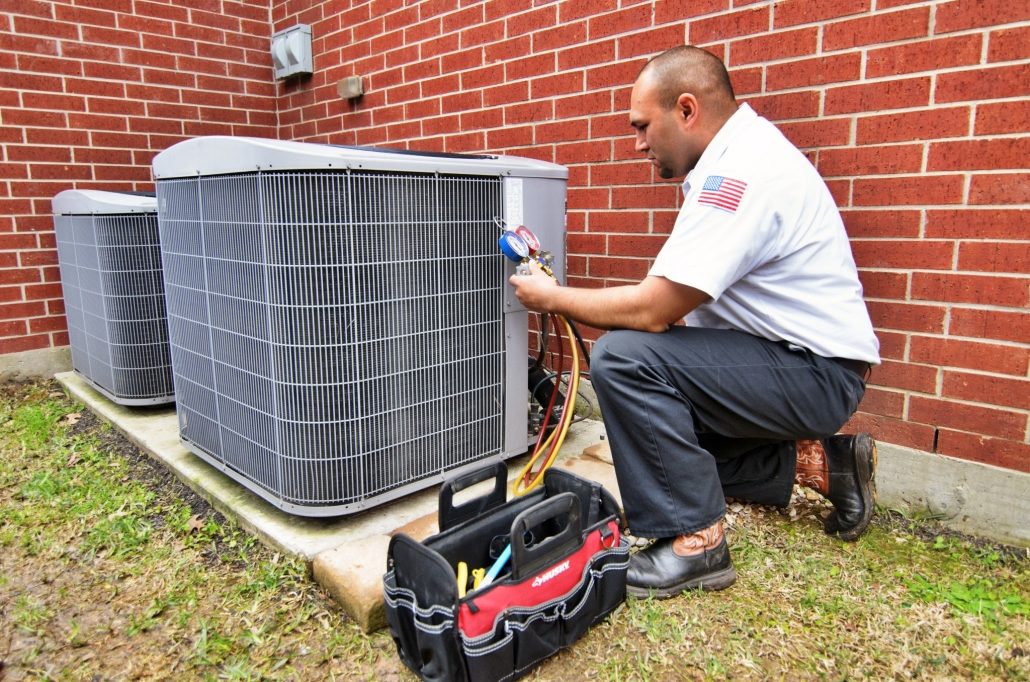


Rising equipment prices, costly credit, expiring tax incentives, weak housing activity, and increasing household expenses are prompting more homeowners to repair rather than replace aging HVAC systems. This pressure is especially acute in Southeast Michigan.
Replacing a furnace or air conditioner has always been costly for Midwest homeowners. In 2026, this decision is further complicated by a challenging mix of economic factors.
Heating and cooling equipment remains expensive, and consumer borrowing costs are elevated.[6][10] Federal HVAC tax credits that reduced the cost of high-efficiency equipment expired at the end of 2025.[8] Housing activity is still limited by mortgage rates near 7%.[12] Inflation continues to erode household income, with energy costs rising rapidly across the Midwest.[3] In some areas, especially Southeast Michigan, job-market weakness adds further uncertainty.[5]
The result is visible in the HVAC industry’s own shipment data.
Through May 2026, U.S. shipments of gas furnaces were down 10.5% from the same period in 2025, according to data from the Air-Conditioning, Heating, and Refrigeration Institute. Central air-conditioner shipments were down 3.4% year to date. AHRI’s shipment reports track U.S. manufacturer shipments of central air conditioners, air-source heat pumps, and furnaces, making them one of the industry’s broadest measures of equipment movement.[1]
These figures do not indicate a decline in the need for heating and cooling. Furnaces and air conditioners still fail, but evidence shows homeowners are increasingly extending the life of existing systems.[2]
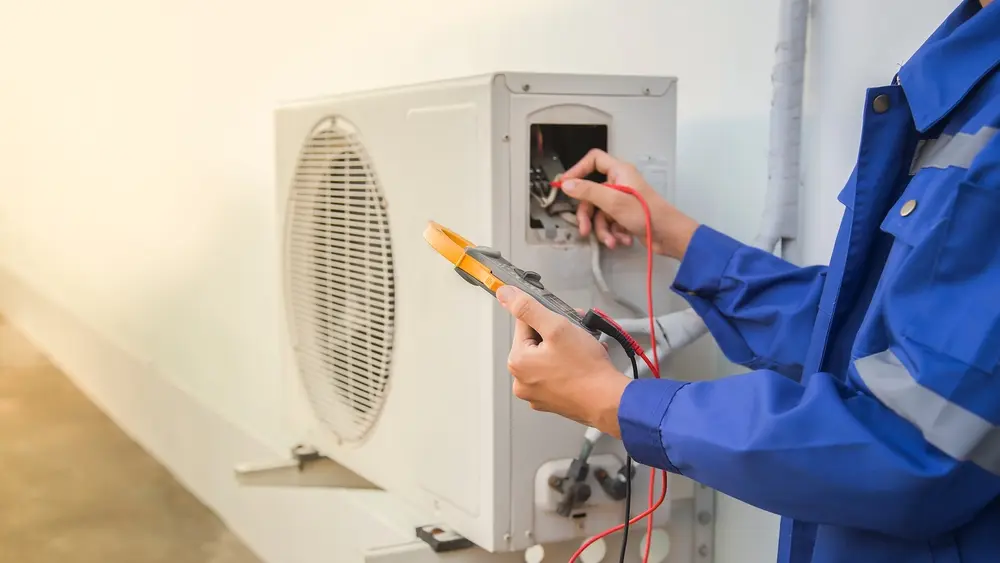
The Decision to Repair or Replace has Shifted
A leading HVAC manufacturer, rather than an economist, provided one of the clearest explanations of the issue.
Lennox reported that revenue in its residential Home Comfort Solutions business declined 7% year over year in the second quarter of 2026, driven primarily by a 12% decline in unit volume. That followed an even steeper first quarter, when residential unit volumes were down 21%.[2]
Lennox executives cited high interest rates, inflation, low consumer confidence, affordability concerns, and weak residential construction as factors limiting demand. They also noted a shift toward repairing existing HVAC systems instead of replacing them.[2]
That Behavior is Economically Rational
A homeowner facing a $1,500 or $2,500 repair on a 12-year-old air conditioner may recognize that replacement is inevitable. While it often makes sense to delay a major purchase, some issues can signal that repair is no longer the most cost-effective option. Signs that replacement may be unavoidable include frequent breakdowns, escalating repair costs, high or rising energy bills due to reduced efficiency, uneven home temperatures, or if the system uses an outdated refrigerant. However, if the alternative is financing a five-figure HVAC system immediately, delaying replacement becomes more appealing.
As a result, the industry continues to see service calls and system failures, but fewer replacements. Demand for comfort persists, while demand for major purchases declines.[2]
This distinction is essential to understanding the 2026 HVAC market.
Homeowners are Managing Heavier Monthly Budgets
The broader Midwest economy is placing additional strain on household finances.
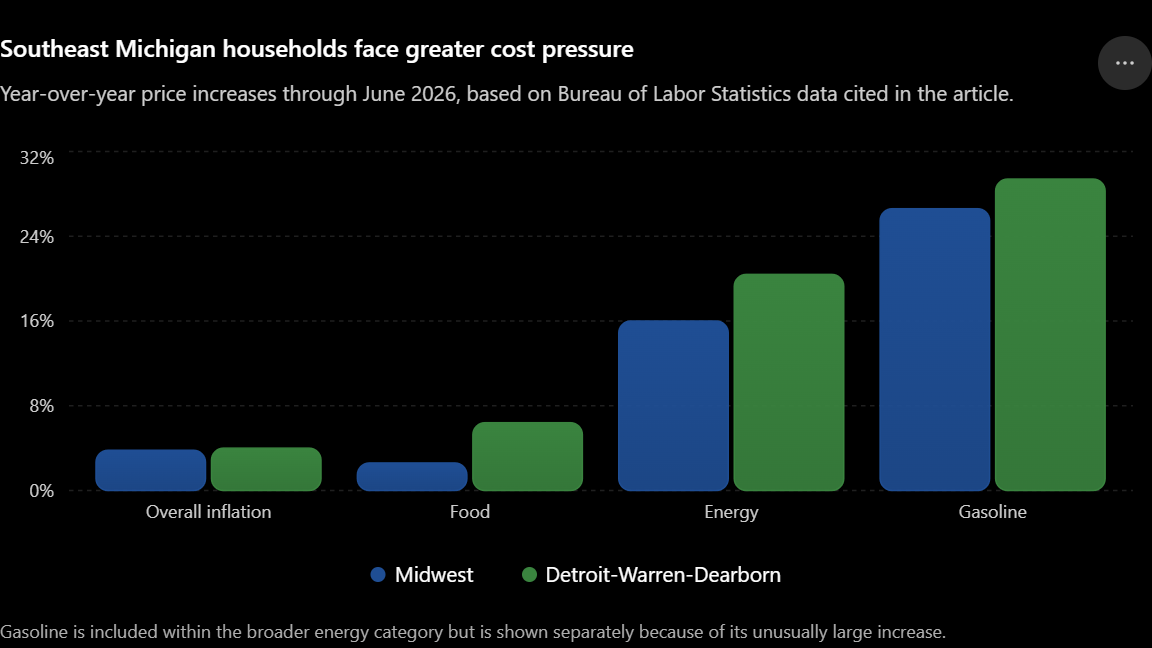
Consumer prices in the Midwest were 3.8% higher in June 2026 than a year earlier, according to the Bureau of Labor Statistics. Food prices were up 2.6%. But the largest increase came from energy.[3]
The Midwest energy index increased 16.0% year over year. Gasoline prices were up 26.6%, while electricity prices climbed 7.7%.[3]
These rising costs are significant for HVAC contractors, as furnaces and air conditioners compete for the same household budget.
Homeowners do not consider HVAC pricing in isolation. They are also managing higher utility bills, grocery costs, gasoline, insurance, housing expenses, and debt payments.
Unlike many discretionary expenses, several of these costs cannot be avoided.
This makes the repair-versus-replacement decision increasingly one-sided. While homeowners may need to fix a failed component, they can often postpone replacing the entire system.
Southeast Michigan Faces Even Greater Financial Pressure
Economic pressure is especially pronounced in the Detroit metropolitan area.
Consumer prices in Detroit-Warren-Dearborn increased 4.0% from June 2025 to June 2026, compared with just 1.3% inflation a year earlier.[4]
Food prices rose 6.4%. Food purchased for home consumption increased 4.8%. Fruits and vegetables were up 8.5%, meats, poultry, fish and eggs were up 6.1%, and cereals and bakery products rose 9.6%.[4]
Energy costs were more striking. Detroit-area energy prices jumped 20.4% year over year, while gasoline prices increased 29.4%.[4]
In summary, Southeast Michigan homeowners considering major HVAC replacements are also facing significantly higher costs for essential household items.
The Detroit Area Labor Market has also Weakened Compared to a Year Ago
Detroit-Warren-Dearborn’s unemployment rate increased from 4.8% in June 2025 to 5.4% in June 2026, a 0.6-percentage-point deterioration. BLS data show Detroit moving in the opposite direction from several other large Midwest metropolitan areas during the same period.[5]
A 5.4% unemployment rate does not mean most homeowners are unemployed. However, replacement demand can decline well before a household loses income.
Concerns about layoffs, reduced hiring, less overtime, uncertain bonuses, and fear of future unemployment all increase the importance of cash reserves. As a result, homeowners are more likely to preserve a functioning but aging furnace rather than replace it proactively.
Borrowing Remains Costly
HVAC replacement decisions increasingly focus on monthly payments.
The Federal Reserve’s latest consumer-credit data show just how costly unsecured household borrowing remains.
Commercial-bank credit-card accounts were carrying average rates around 20.94%, while accounts actually assessed interest averaged approximately 22.15%. The average rate on a 24-month personal loan was approximately 11.86%.[6]
HVAC financing products may not match these exact rates, as contractors often use promotional loans, dealer-subsidized financing, or specialized lenders. Homeowners should ask local HVAC contractors about current financing options, including special deals or flexible payment plans that may be available in their area. These offerings can sometimes help make essential system replacements or repairs more manageable, even in a tough credit environment. However, Federal Reserve data reflect the broader consumer credit environment affecting HVAC financing.
Credit Availability also Remains Tight
In its July 2026 Senior Loan Officer Opinion Survey, the Federal Reserve reported that consumer-loan standards remained at the tighter ends of their historical ranges. A modest net share of banks tightened credit-card standards during the second quarter. For subprime borrowers, banks reported particularly tight conditions across credit cards, auto lending and other consumer loans.[7]
The challenge extends beyond whether a homeowner can technically qualify for financing.
The payment amount itself can become a barrier.
As installed prices increase, so do monthly payments for replacement systems. Homeowners with lower credit scores may face less favorable financing terms. A repair costing several thousand dollars may seem more manageable than years of additional monthly payments.
A Key Industry Sales Tool Expired on January 1
The expiration of federal energy-efficiency tax incentives complicates comparisons with 2025.
Under the Energy Efficient Home Improvement Credit, homeowners could previously claim 30% of certain qualifying expenses. The annual credit included up to $2,000 for qualifying heat pumps, with other qualifying energy-efficiency improvements eligible for credits within a separate $1,200 annual limit.[8]
Those credits were available only for qualifying property placed in service through December 31, 2025. They are no longer available for 2026 installations.[8]
ENERGY STAR materials advertised potential savings of up to $2,000 on qualifying heat-pump technology, giving contractors and consumers a tangible way to reduce the perceived net purchase price.[9]
This incentive ended just as households were already facing affordability challenges.
The psychological impact is significant.
A homeowner evaluating an eligible $15,000 heat-pump installation in 2025 could potentially view the purchase through the lens of a $2,000 federal tax credit. In 2026, that same incentive no longer exists.[8][9]
Even if a credit does not alter the contractor’s invoice, it influences how consumers perceive the effective project cost.
For an industry selling high-cost equipment, the loss of substantial incentives creates a particularly unfavorable year-over-year comparison.
HVAC Equipment Prices Continue to Rise
Equipment prices have offered little relief to homeowners.
The Bureau of Labor Statistics Producer Price Index for air-conditioning, refrigeration and forced-air heating equipment manufacturing reached 320.969 in June 2026, compared with 311.838 a year earlier, an increase of approximately 2.9%.[10]
Another BLS series covering HVAC and commercial refrigeration equipment increased from 235.645 in February to 238.960 in June 2026, indicating additional producer-price pressure within the first half of the year.[10]
Parts are getting more expensive as well. The producer-price index for parts and accessories used in air conditioning and heat-transfer equipment rose from 283.817 in February to 286.939 in June.[10]
These Increases Add to Years of Cumulative HVAC Inflation.
For homeowners, the key figure is not the percentage increase in manufacturer indexes, but the final installed price.
Equipment, refrigerant, labor, vehicles, insurance, financing, and overhead all contribute to the final quote presented to the homeowner.
As the total cost rises, homeowners find it easier to justify another repair.
The Refrigerant Transition Has Introduced Additional Costs
The industry is undergoing one of its most significant equipment transitions in years.
Federal rules governing hydrofluorocarbons have shifted new residential HVAC equipment away from higher-global-warming-potential refrigerants such as R-410A and toward lower-GWP alternatives.[11]
This transition impacts manufacturers, distributors, and contractors across the supply chain. New equipment platforms require redesigned components, new refrigerants, revised handling procedures, and updated training and tools.
Critically, the rules allow existing R-410A systems to continue being serviced and repaired even as the market for new systems moves toward the newer refrigerant platforms.[11]
This creates a strong consumer incentive: repairing existing equipment remains an option, even when replacement would require adopting a new equipment generation. In simple terms, while new systems now use a different, more environmentally friendly refrigerant, homeowners with older units can still have those systems repaired and serviced as usual. The refrigerant change only affects new equipment installations, not the ability to maintain or repair existing systems.[11]
For homeowners seeking to minimize immediate expenses, this distinction further encourages repair over replacement.
The Housing Market is Offering Little Support
HVAC demand is also tied to housing activity.
Home sales create natural opportunities for system replacement: inspections uncover aging equipment, buyers renovate newly purchased homes, sellers replace failed systems to complete transactions, and household moves generate remodeling spending.
However, mortgage rates remain historically high by recent standards.
The average 30-year fixed mortgage rate was 6.69% as of August 6, 2026, according to Freddie Mac. One year earlier, it was 6.63%.[12]
High mortgage rates have made homeowners with older, low-rate mortgages reluctant to move, while prospective buyers face significantly higher monthly payments.
This weakness extends to new residential development.
U.S. building permits ran at a seasonally adjusted annual rate of 1.367 million in June 2026, down 3.0% from May and 2.3% from June 2025. Single-family authorizations fell another 2.4% in one month, to an annual rate of 871,000.[13]
For HVAC companies involved in new construction, fewer authorized homes mean fewer future installations. For replacement contractors, slow turnover further reduces high-intent equipment demand.
These Pressures are Compounding Rather than Acting Independently
None of these factors exist in isolation.
- Homeowners may face all of the following at once:
- higher food prices;
- higher energy bills;
- a weaker local job market;
- an HVAC system that costs more to replace;
- consumer credit rates well into double digits;
- tighter lending standards;
- mortgage rates near 7%;
- and the loss of a federal tax credit that was available only months earlier.
This Combination is Altering Consumer Behavior
It lowers the threshold for price sensitivity, increases the importance of monthly payments, raises the value of preserving cash, and makes a large repair bill more acceptable if it delays an even larger replacement expense.
The industry’s results increasingly reflect this shift in consumer behavior. Lennox’s 12% decline in residential unit volume during the second quarter is not occurring because Americans suddenly stopped needing heating and cooling. The company’s own explanation centers on affordability, interest rates, consumer confidence, weak housing construction, and the movement from replacement toward repair.[2]
A 10.5% decline in gas-furnace shipments through May provides further evidence of these market pressures.[1]
These Factors are Hitting the Midwest Hard
In the Midwest, national HVAC pressures are compounded by 3.8% regional inflation and a 16% rise in energy prices.[3] In Southeast Michigan, these are further intensified by 4% inflation, 6.4% food inflation, 20.4% energy inflation, and a metro unemployment rate of 5.4%.[4][5]
You Should Consult with an HVAC Professional to Navigate These Challenges
This represents a significant set of challenges for an industry centered on one of the largest unplanned purchases homeowners face. However, homeowners do not have to navigate these decisions alone. By consulting with trusted HVAC professionals, homeowners can receive guidance tailored to their specific needs, learn about all available options, and make informed choices that best fit their financial situation. Regular maintenance and honest conversations with reputable contractors can help reduce unexpected costs and keep systems running reliably, even in a difficult market.
Endnotes
[1] Air-Conditioning, Heating, and Refrigeration Institute (AHRI), “May 2026 U.S. Heating and Cooling Equipment Shipment Data,” July 10, 2026. AHRI reported year-to-date gas warm-air furnace shipments of 1,232,653 units through May 2026 versus 1,377,374 in 2025, a decline of 10.5%. Central air-conditioner shipments totaled 1,955,106 versus 2,022,984, a decline of 3.4%. AHRI notes that its monthly statistics represent shipments to customers within the 50 states and the District of Columbia and are aggregated from participating member companies. Source
[2] Joanna R. Turpin, “Lennox Residential HVAC Sales Fall 7% in Second Quarter,” ACHR News, August 3, 2026. Lennox Home Comfort Solutions revenue declined 7% in Q2 2026 as unit volume fell 12%; residential volume had declined 21% in Q1. CEO Alok Maskara cited elevated mortgage rates, inflation, low consumer confidence, affordability pressure, weather variability and weak residential new construction. Lennox also said repairs were representing deferred replacements and that affordability remained a barrier. Source
[3] U.S. Bureau of Labor Statistics, “Consumer Price Index, Midwest Region — June 2026,” July 14, 2026. Midwest CPI-U increased 3.8% over the 12 months ending June 2026. Food increased 2.6%; energy increased 16.0%; gasoline increased 26.6%; and electricity increased 7.7%. Shelter increased 4.3%. Source
[4] U.S. Bureau of Labor Statistics, “Consumer Price Index, Detroit-Warren-Dearborn Area — June 2026,” July 14, 2026. Detroit-area CPI-U increased 4.0% over the year, compared with 1.3% in June 2025. Food rose 6.4%; food at home 4.8%; fruits and vegetables 8.5%; meats, poultry, fish and eggs 6.1%; cereals and bakery products 9.6%; energy 20.4%; and gasoline 29.4%. Source
[5] U.S. Bureau of Labor Statistics, “Unemployment Rates Down in 27 Large Metro Areas, Up in 26, Over Year Ended June 2026,” August 3, 2026. The unemployment rate in Detroit-Warren-Dearborn increased from 4.8% in June 2025 to 5.4% in June 2026. For comparison, Grand Rapids declined from 4.8% to 4.2%, Cleveland from 4.5% to 3.5%, and Indianapolis from 3.6% to 3.4%. The metropolitan figures are not seasonally adjusted, and June 2026 data were preliminary when published. Source
[6] Board of Governors of the Federal Reserve System, “Consumer Credit — G.19,” June 2026 release, August 7, 2026. For Q2 2026, the average commercial-bank interest rate was 20.94% on all credit-card accounts, 22.15% on credit-card accounts assessed interest, and 11.86% on 24-month personal loans. Source
[7] Board of Governors of the Federal Reserve System, “The July 2026 Senior Loan Officer Opinion Survey on Bank Lending Practices,” August 3, 2026. The Federal Reserve reported that standards for all categories of consumer loans were at the tighter ends of their historical ranges, with particularly restrictive conditions reported for subprime credit cards, auto loans and other consumer credit. Source
[8] Internal Revenue Service, “Energy Efficient Home Improvement Credit,” updated April 28, 2026. The credit equaled 30% of certain qualifying expenses and was available for qualifying improvements through December 31, 2025. The annual limits included up to $1,200 for certain efficiency improvements and residential energy property, plus a separate limit of up to $2,000 for qualified heat pumps, heat-pump water heaters, biomass stoves, and biomass boilers. Source
[9] ENERGY STAR, “Air Source Heat Pumps Tax Credit” and “Federal Tax Credits for Energy Efficiency.” ENERGY STAR listed a federal credit equal to 30% of qualifying air-source heat-pump project costs, up to $2,000, for eligible products purchased and installed from January 1, 2023 through December 31, 2025. Source
[10] U.S. Bureau of Labor Statistics Producer Price Index data, retrieved through the Federal Reserve Bank of St. Louis FRED database. The PPI for air-conditioning, refrigeration, and forced-air heating equipment manufacturing was 320.969 in June 2026, compared with 311.838 in June 2025, an increase of approximately 2.9%. The HVAC and commercial refrigeration equipment index increased from 235.645 in February 2026 to 238.960 in June, while the parts and accessories index for air-conditioning and heat-transfer equipment increased from 283.817 to 286.939 over the same period. Source
[11] U.S. Environmental Protection Agency, Technology Transitions Program and “Frequent Questions on the Phasedown of Hydrofluorocarbons.” EPA restrictions transition new residential and light-commercial air-conditioning and heat-pump systems away from refrigerants above specified global-warming-potential limits. Existing R-410A equipment may continue to be repaired, and components may continue to be manufactured and sold for servicing existing systems. Beginning January 1, 2026, R-410A components generally cannot be combined to install a new R-410A residential system but can still be used to service legacy equipment. Source
[12] Freddie Mac, “Primary Mortgage Market Survey,” August 6, 2026. The average U.S. 30-year fixed-rate mortgage was 6.69% for the week ending August 6, 2026, compared with 6.63% one year earlier. Source
[13] U.S. Census Bureau and U.S. Department of Housing and Urban Development, “New Residential Construction, June 2026,” July 17, 2026. Privately owned housing units authorized by building permits were running at a seasonally adjusted annual rate of 1.367 million, 3.0% below May and 2.3% below June 2025. Single-family authorizations were 871,000, 2.4% below the revised May rate. Source